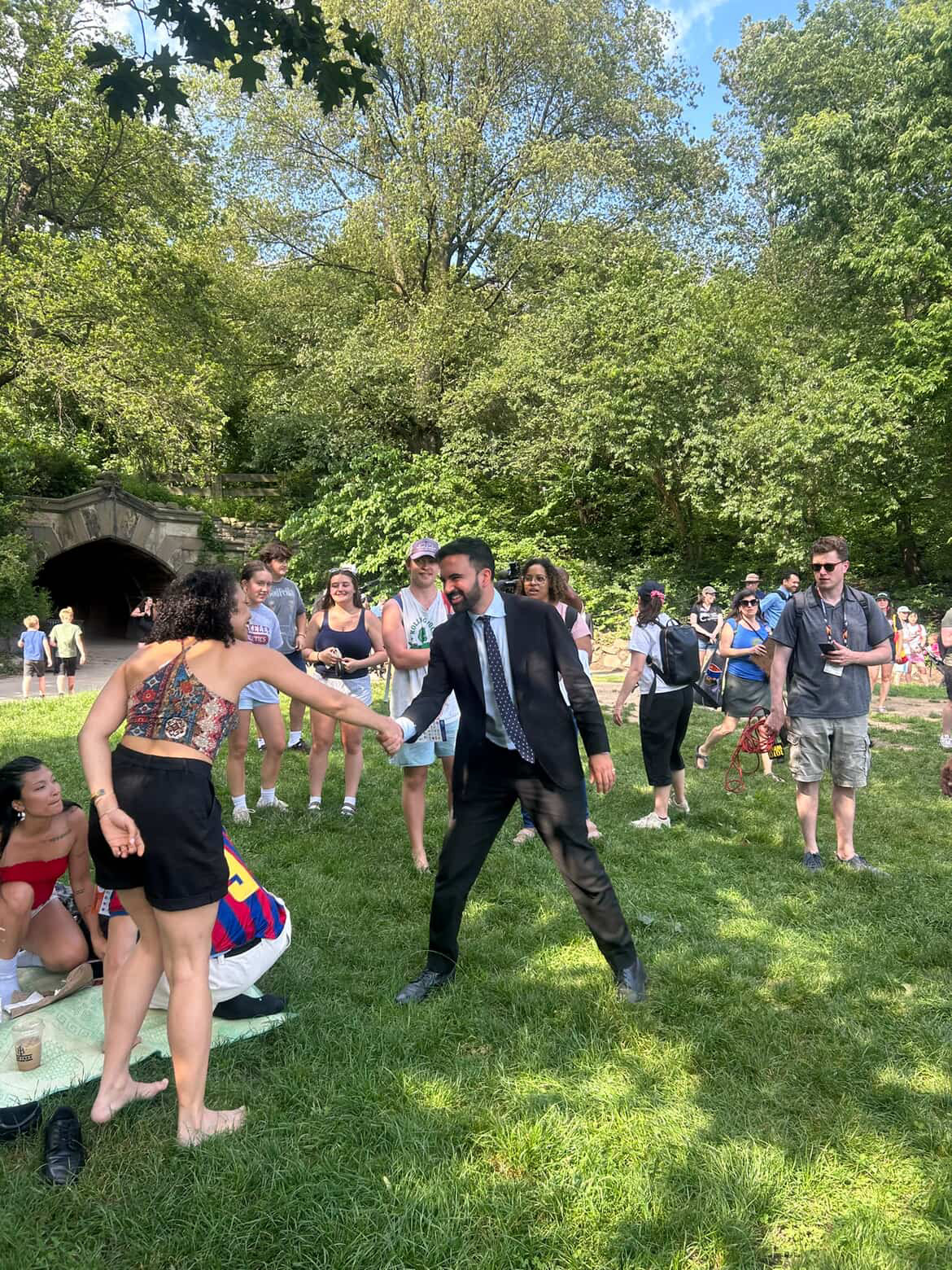
Elections, save from presidential ones, don’t usually get much attention from the general populace. Even though they are a staple to our democracy, candidates find it hard to catch the eye of the public and make them excited to go out and vote. So why is this mayoral election garnering so much recognition? Why is it different from previous elections and what should you know about it?
First, this election comes in the middle of an emotional time. Tensions are rising around the country as some politicians retreat further and further into their hyper-partisan politics, while others water down their policies so as not to offend any voters. With the recent government shutdown and a lack of real interest in getting it up and running again, it’s understandable if some might be a little sick of politics.
This government shut down is only the latest in a long line of political issues in the past year, including many clashes between federal and state governments over the National Guard in American cities; dozens of tariffs being announced, only to be rescinded and then announced again; the slashing of federal aid to countries around the world; and the crumbling of America’s relationships with longtime allies. We don’t know our standing in the world and it’s hard to find a real place in politics.
The Democratic Party has seen the brunt of this loss of faith, its members being disappointed with the outcome of the last presidential election, in which they lost not only the White House, but Congress as well. Many have been saying that the party doesn’t stand for anything, it just stands against Republicans. And yet, some Democratically aligned politicians haven’t even been doing that.
Assemblymember Zohran Mamdani, the Democratic Nominee for New York City Mayor, has recently gained traction where more moderate Democrats have failed. Winning his primary with 56.4% of the votes and having 52% in recent polling data, Mamdani has managed to gain Democratic favor in a time when voters have been disappointed by Democratic leadership. His campaigning on social media and his policies have captured the young vote of New York City, and created an excitement that hadn’t seemed possible a short time ago.
As a member of the Democratic Socialists of America (DSA), and an Assemblymember in the New York State Legislature, Mamdani has fresh ideas to bring to the table. His platform focuses on affordability and includes freezing rent on rent stabilized apartments, fast and free buses, and municipal grocery stores. These ideas, as well as Mamdani’s DSA membership, have drawn negative attention from other candidates, even Democratic ones, who criticize him for being too leftist. But it is specifically this partisan tilt to Mamdani’s politics that is so appealing to the young Democrats of NYC.
In this time of political polarization, prominent Democrats have been surprisingly moderate in comparison to their Republican counterparts. This is understandable: bi-partisanship is one way to combat polarization. But young Democrats are sick of compromise and Mamdani’s politics are new and exciting to many of them. He isn’t making his image one of capitulation or surrender, as he made clear in the recent debate when he disagreed with Curtis Sliwa, Republican nominee, on how to work with President Donald Trump. While Sliwa said that getting “tough” with President Trump will only harm the citizens of New York, Mamdani expressed that working with the president will require “leadership that will stand up to him.” Of course, while many Democrats have made these types of statements, it’s only recently that they have been following through with them.
Despite this willingness to stand up to Republican politicians, Mamdani’s campaign seems to focus more on his policies than being anti-Republican. This also strays from the current norm; many complained about Kamala Harris’s campaign not having anything to say and only offering an alternative to President Trump, with no solid ideals.
Because of this new style of campaign, young voters had the highest turnout of all age groups in the primary, with 35.2%. In fact, Mamdani brought out not just young voters, but the highest voter turnout in a decade at 29.9% of registered voters. That’s nearly 1.1 million New Yorkers.
Of course, not all 1.1 million voted for Mamdani. Many New Yorkers are just as wary of Mamdani and his policies as other politicians. Andrew Cuomo, Mamdani’s main competitor and former Governor of New York, often plays on this distrust, posing himself as the only candidate who can beat the Assemblymember. This animosity is apparent in many of their interactions with each other. Much of the debate on October 16th had both Cuomo and Mamdani taking potshots at each other. Cuomo said that Mamdani has “no management experience” and doubled down on his previous statement of Mamdani being a “terrorist sympathizer,” while Mamdani reminded viewers of Cuomo’s sexual assault alligations and how he “[sent] seniors to their death[s] in nursing homes” during the Covid-19 pandemic.
While the environment in the election is competitive and sometimes hostile, it makes it more likely for people to come out and vote.
In general, local elections for mayor, council members, district attorneys, assembly members, and others usually have low voter turnout. This is an issue in a democracy, since one wants to get as many voices as possible, making the election more fair. Mamdani, by being partisan, and Cuomo, by being polarizing, are bringing more people to the polls.
There have been many attempts made by politicians to increase voter turnout, but you cannot create interest in local elections artificially. An increase in voter turnout is needed, and it will happen naturally if there is an interest in the candidates.
This year there is an interest in the candidates, and hopefully our democracy will serve us with a candidate that wants the best for all New Yorkers. This is a significant election that will decide what New York becomes for the next four years. As high school students, our power over the outcome of this race may seem insignificant, but it is far from that. While we cannot vote yet, there are many people in our lives that can and our impact on them should not be underestimated. Talk to your family, your friends, those in your lives who can vote, and tell them to do so. Early voting started October 25th.