©NBC/Courtesy Everett Collection
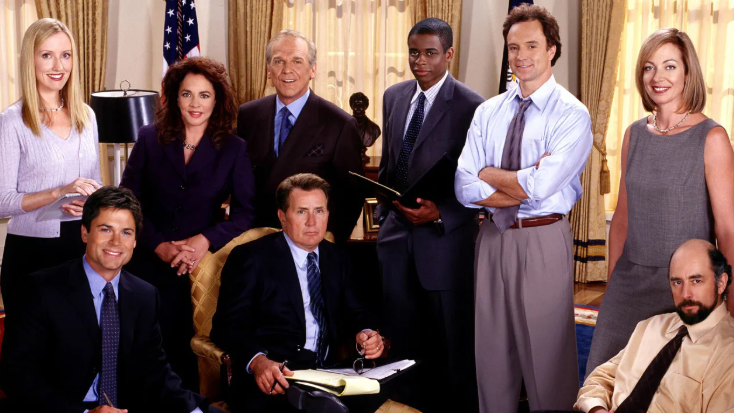
The West Wing is a political drama that follows the work lives of the senior staff of made-up President Josiah Bartlet (Martin Sheen) during his presidency. Created by Aaron Sorkin (who also wrote for the first four seasons), The West Wing ran on NBC from September 22, 1999 to May 14, 2006. It starred Martin Sheen, Rob Lowe, Allison Janney, Richard Schiff, Bradley Whitford, and John Spencer.
The West Wing is a complex yet rewarding show that you understand more and more each time you watch it. Starting at the beginning of President Bartlet’s first term, it introduces multiple plot lines per episode, which are sometimes hard to keep track of but get better and better on each rewatch.
Performances by the actors are compelling, even if it is hard to imagine a president would be that honorable in real life. Episodes oscillate between pessimism about the state of our world and optimism about the possibilities of democracy, creating a believable balance between the two.
Though it can be confusing, whenever the authors of the show suspect that the audience may be more confused than usual they insert a character that is also confused. That character will admit not knowing something, and then another character will explain throughout the episode. One fault of this method, while it is very helpful for understanding the show, is that the unknowing character is often a woman. Usually it’s one of the secretaries, though there’s an episode where the president’s Press Secretary (a high ranking senior staffer), played by Allison Janney, has to get the census “mansplained” to her by one of the other leads, Rob Lowe.
In the first season there are many very good episodes, but two that stand out are “Pilot” and “Five Votes Down”.
“Pilot”, which is the first episode, can be a little overwhelming the first time around, since it throws you right into the middle of a busy day. Conversations flow from one topic to the next in seconds and missing something can lead to the audience feeling disoriented in later scenes. Despite this, the episode is exceedingly well written and I’ve likely watched it with my family more than five times.
“Five Votes Down” is a similar story. As the fourth episode of the first season, it follows the events that occur after losing five crucial votes on a gun control bill in Congress. The senior staff needs to wrangle five votes in the little time they have before the bill is up for vote, leading to some amusing conversations between Bradley Whitford’s character, the Deputy Chief of Staff, and various congressmen. This was the first West Wing episode that I ever watched, and it never gets old.
Also, despite the intelligence of the episodes, it’s a little dated. It’s not shockingly sexist or racist, like some older shows that your parents will show you, but The West Wing came out near the beginning of the 21st century, and follows some politics that are less relevant today.
On the other hand, it’s sometimes shocking how accurate the politics are. Issues in the Middle East plague the White House in season 5 through the end. Healthcare and gun control are common topics. Abortion is touched on, along with police brutality, racism, immigration, and Islamophobia. There’s issues with white supremacists who send death threats to the personal aide to the President, a character played by Dulé Hill. Some of the characters also display a certain ultra-partisan quality that is very recognizable in this day and age.
The West Wing is a show that makes politics accessible and understandable. Almost every episode has a bill the White House is trying to get passed on Capitol Hill. Since it’s brought up so much, viewers become an expert in the process. They have scenes in the Situation room—the “Sit” room, as they call it—that give you an idea of what a president might be doing during an issue of national security or danger abroad. I’ve learned everything from what a filibuster is to how social security works, and that isn’t the half of it.
The West Wing is also the kind of show that can make you hopeful. Hopeful that the democracy made 250 years ago can last because of its safeguards. Hopeful that good people will go into politics and, while the game changes everyone who plays it, hopeful that those people won’t lose their belief in making change and bettering our society. It makes you hopeful for bipartisanship and honest politicians, as impossible as those seem right now.
I would recommend this show to anyone who is interested in politics, even vaguely. If you want to feel a little more optimistic about the state of our union than you might right now, The West Wing is a good show to watch. And I’m not just saying this because it has the same name as our newspaper.