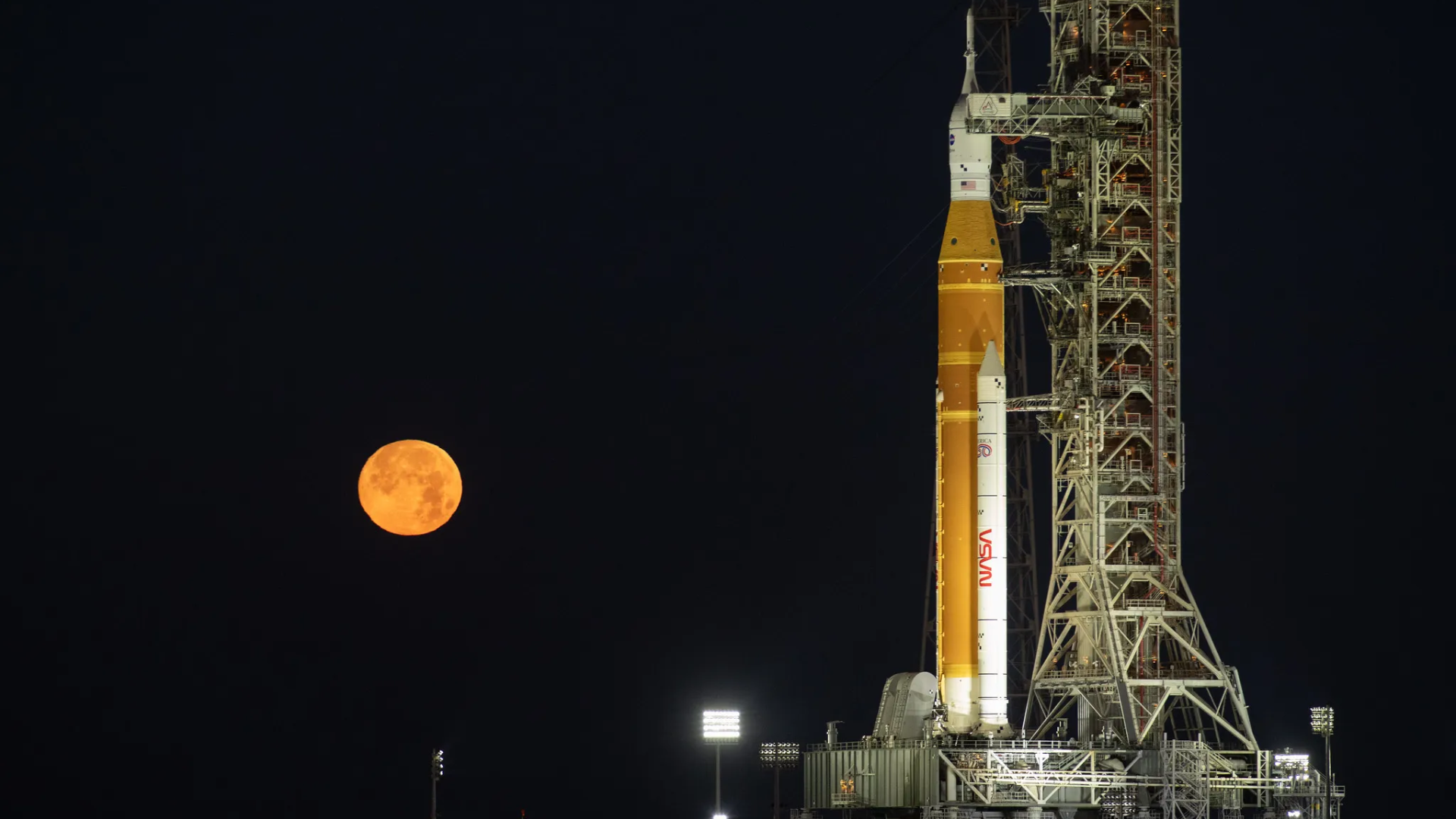
Cheryl Warner, “NASA Strengthens Artemis” NASA.gov
The phrase “bread and circuses,” originates from ancient Rome, and describes a governing strategy in which public spectacle and material appeasement are used to distract citizens from government problems or other political issues. The 2026 Artemis II mission (NASA’s first crewed lunar flyby in over half a century), can be interpreted through this lens. While it may undeniably be a technological achievement, its timing, cost, and political context raise questions about whether it functions partly as a modern spectacle masking deeper tensions in the U.S. government.
The Spectacle: Awe, National Pride, and Strategic Messaging
Artemis II marked a historic milestone: humans traveling beyond low Earth orbit for the first time since the Apollo era. It generated global attention, revived national pride, and reinforced the United States’ position in a renewed space race.
Achievements such as these are not trivial. Governments have long used ambitious technological feats such as moon landings, Olympic Games, and megaprojects, to project competence and unity. Artemis II absolutely fits into this tradition. The emotional power of astronauts orbiting the moon provides a compelling narrative of progress and destiny, one that is politically useful in moments of domestic uncertainty. An inspirational space mission such as Artemis II feeds into people’s nationalistic ideals, which can be said to be beneficial for any government system which desires to mislead its people.
The Cost: A Multi-Billion-Dollar Performance
Spectacle comes at a price. Artemis II alone cost roughly $4.1 billion per launch, while the general Artemis program is projected to exceed $93–105 billion throughout the first lunar landing, later this decade.
Critics argue that such spending reflects questionable priorities. One op-ed compared the cost of a single launch to significant portions of federal science or health budgets, suggesting that the same funds could produce more immediate societal benefits. “Sen. Richard Blumenthal: Don’t Nickel-And-Dime Veterans.” (The Washington Post, 13 Apr. 2026).
From a “bread and circuses” perspective, the issue is not simply that the program is expensive, but that its symbolic value may outweigh its practical return in the short term. Artemis II did not land on the moon, it tested systems for future missions.
The Contradiction
The most striking element of this whole subject, and the core of the “bread and circuses” argument, is the apparent and obvious contradiction in federal policy.
While celebrating Artemis II, the U.S. government has proposed cutting NASA’s overall budget by about 23%, including nearly halving science funding by 47%.
At the same time, funding for Artemis itself is preserved and even increased, with billions allocated specifically for lunar exploration.
This creates a paradox:
- High-visibility human spaceflight is prioritized
- Lower-visibility scientific research, education, and long-term innovation are reduced
In other words, the most publicly dramatic component is protected, while quieter and arguably more foundational work is cut. This aligns closely with the classical model of spectacle over substance.
Political Context: Public View in a Competitive and Polarized Era
The Artemis program unfolds within a complex political environment:
- Intensifying geopolitical competition (especially with China in space)
- Domestic political polarization
- Budget pressures and debates over federal spending priorities
In such a context, Artemis II serves multiple political functions:
- National unity symbol
- Geopolitical signal which functions to demonstrate technological leadership
- Distraction tactic: shifting public attention toward triumph rather than austerity
Historically, large-scale space programs, from Apollo to the Space Shuttle, have always been partly political. Artemis II continues that tradition, however in a more fragmented media and political landscape, its role as spectacle may be even more pronounced. Ergo reinforcing the bread and circuses theme we continue to see.
Not purely symbolic? Economic and Industrial Impact
However, reducing Artemis II to just a spectacle would be inaccurate. The program supports:
- Hundreds of jobs across 2,700+ companies in over 40 states. “Florida’s Slice of NASA’s Artemis Pie Nets Thousands of Jobs, Billions of Dollars Each Year.” Orlando Sentinel, 22 Mar. 2026,
- Advances in aerospace engineering, materials science, and deep-space systems
- Long-term ambitions such as lunar infrastructure and Mars exploration
These tangible benefits complicate the “bread and circuses” critique. Unlike Roman games, Artemis produces technological advancements and industrial growth. The debate, therefore, is not whether it has value, but more so whether its value is proportionate to its cost and political prioritization.
The Upshot
Artemis II sits at the intersection of genuine achievement and political theater. It is both:
- A real step toward sustained human space exploration
- A highly visible, emotionally resonant event that coincides with cuts to less visible but simultaneously critical programs.
The mission exemplifies how modern governments attempt to elevate symbolic, media-friendly accomplishments while quietly reducing investment in less visible public goods under the radar.
All in all the deeper question is not whether the Artemis II program itself deserves to exist, rather whether its prominence reflects a balanced national strategy, or a preference for spectacle in an era where optics increasingly compete with substance