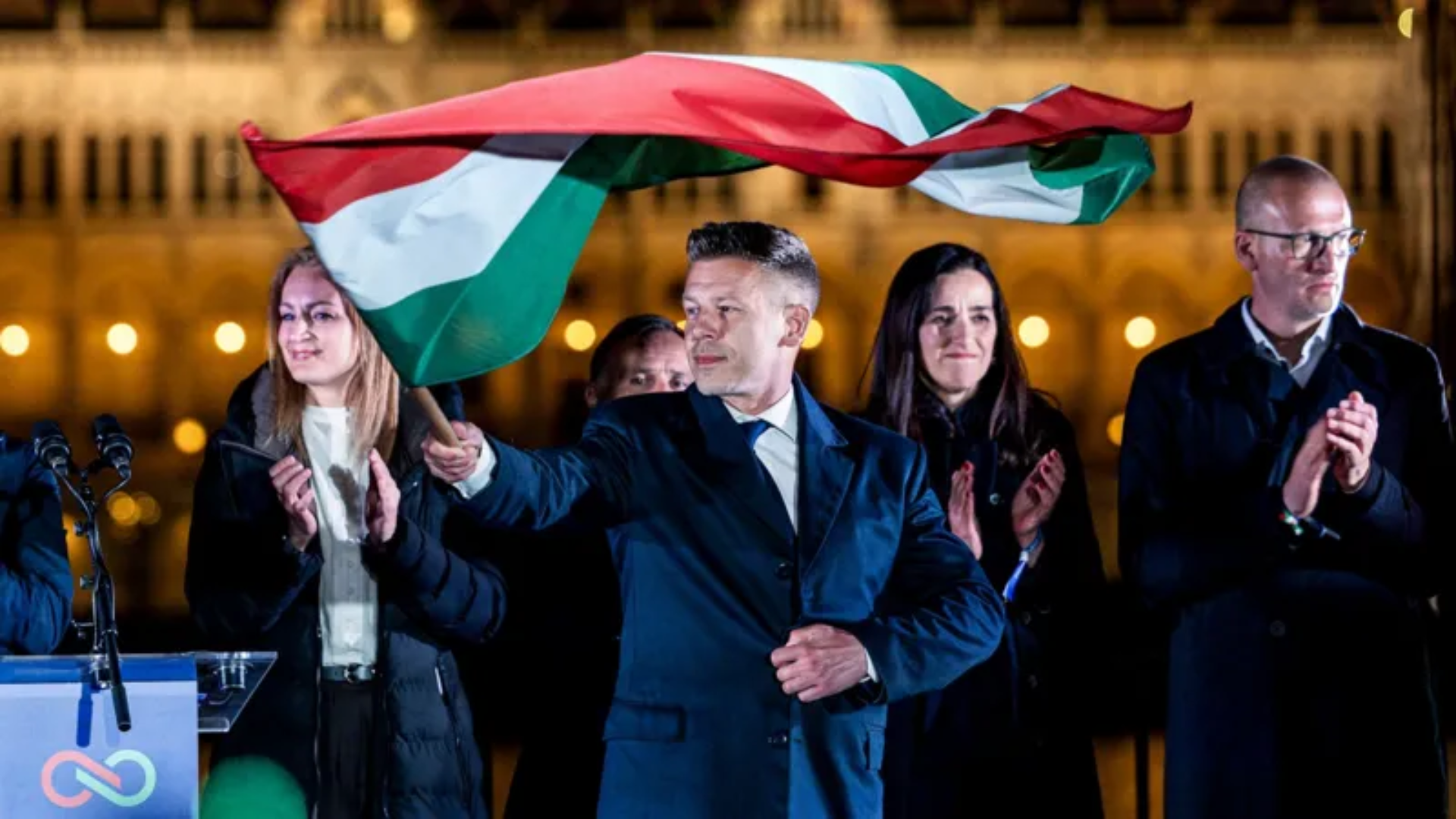
Stiller, Akos. Péter Magyar is on course for a constitutional majority he needs to reverse Orbán-era reforms. 2026, Bloomberg via Getty Images.
On April 12, 2026, Viktor Orbán, longstanding prime minister of Hungary lost his seat after 16 consecutive years (plus four previously) in office.
First elected in 1998, Orbán was the leader of Fidesz. While many today know the party as conservative, the party hadn’t started out that way. It had started out as a liberal opposition to Hungary’s Soviet-backed regime (Schwartzburg and Szijarto). As the years passed, Orbán shifted his party to the right: it was considered a center-right party by the time he was first elected to office.
In his first term Orbán appointed many ministers that had no connections to earlier governments. He also attempted to move the country closer to a free-market economy and oversaw Hungary’s entry to the North Atlantic Trade Organization (NATO) in 1999. He then lost the leadership of his party and then the premiership for a brief time before gaining both back again following a scandal in the opposing party.
In his second term, he gained a supermajority in parliament and passed sweeping reforms, including the adoption of a new constitution embodying conservative moral and religious themes. Despite claims from the opposition that poverty was increasing, the economy slowing, and that Fidesz was corrupt and authoritarian, the party received another majority in the 2014 elections, largely because of the popularity of the government ordering utility companies to reduce charges for Hungarian households.
Orbán’s third term began with his stating that he wanted to create an “illiberal democracy,” similar to Russia, China, and Turkey. This term and the one following it was characterized by strong anti-immigrant sentiment and dominance over the media in Hungary, making it hard for opposition parties to gain traction.
So, how did this landslide victory (two thirds of the parliament) for Péter Magyar and his center-right Tisza Party occur when they faced many obstacles? Not only did they have much less funding for a campaign than the sitting prime minister, but they had much less media access and their party had only just come onto the political scene (qtd. in NPR).
To raise support for his campaign, Magyar travelled around the country in the two years leading up to it, visiting villages, town squares, and cities, speaking to Hungarians who had had enough of the government’s corruption and cronyism. This is a stark contrast from campaigns we know in the US, plastered all over TV stations and social media. Magyar likely would have wished to have such a campaign, but due to his predecessor’s heavy restriction of the media, it was unrealistic.
Yet still, despite his lack of positive media coverage and his disadvantage of being so new on the scene, he brought Hungarian citizens to the polls in droves. A record of 79.5% of the electorate voted. “Never before in the history of democratic Hungary have so many people voted – and no single party has ever received such a strong mandate,” Magyar said in a speech following the election (BBC).
During his campaign, Magyar made promises to redemocratize the country, which he now has the power to do, though critics have reason to question those promises. Magyar was formerly an Orbán supporter, even known as a party insider by the media and the Hungarian public.
This election is promising for those who oppose Orbán’s views—his anti-immigrant policies and his support of leaders like Russia’s Putin and America’s Trump—but it is hard to tell whether this election shows major change in the politics of Hungary. Remember, Magyar’s Tizsa party is designated as center-right. This was the same designation that Fidesz held before its drastic shift to the right.